A Book’s Title Is a First Handshake
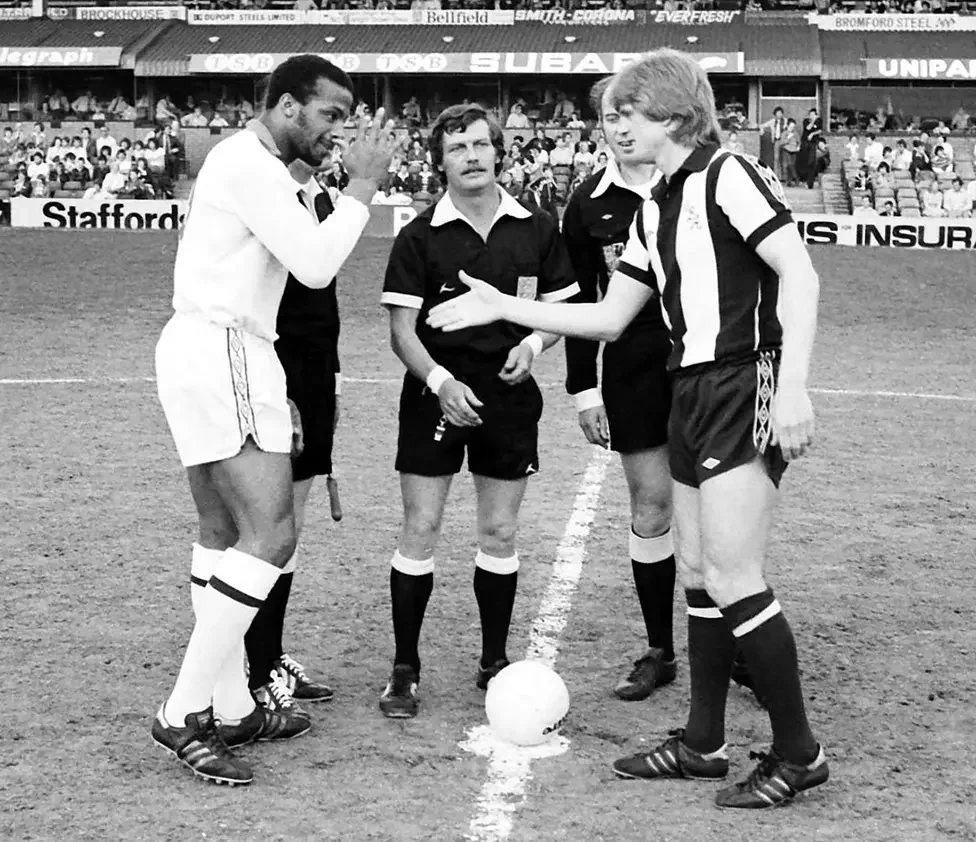
The post-match handshake: a gesture of congratulations, an acknowledgment of fair play, the bridging of intense physical competition with mutual dignity. The pre-match handshake? Its symbolism carries similar weight while representing concepts a bit more layered and sacrosanct: a clean slate, a truce, equality.
Before the opening whistle sounds, the scoreboard wears its most comforting face: nil-nil. Shaking hands reinforces the idea that both sides commence the match with no presumed biases or unfair advantages or rancor born from the past. Echoing ancient customs, this centre-circle ritual tells everyone watching – at the ground, in front rooms, in pubs – that the impending struggle is an athletic test and not an act of personal hostility or conflict. (And this ideal of equality is nowhere more evident than in the above photograph, snapped prior to West Bromwich Albion’s testimonial match for midfielder Len Cantello that pitted a team of white British and Irish players against a side of black British players. The latter won 3-2.)
Books feature a pre-match handshake, too – and it arrives in the form of a title, arguably the most critical piece of copy an author writes. It carries a massive amount of responsibility for a new release’s ultimate commercial success. The title’s objectives are exacting: to intrigue a stranger, signal the genre, be memorable and searchable and still feel applicable once the book is completed.
While researching the ‘game of the century,’ I went hunting for how the match was reported by newspaper writers later that evening and the following morning. A headline in the 31 December 1978 edition of the Observer caught my eye: ‘The Avalanche in the Snow.’ An apt description for my book, for an avalanche is sudden and relentless, and so was the football that afternoon: five goals in 12 minutes, the lead changing hands, all under falling snow.
The report was by Julie Welch. In August 1973, she became the first woman in Fleet Street to write about English football. The Observer sent her to Highfield Road, where she watched her beloved Tottenham Hotspur lose 1-0 to Coventry. Welch needed half a pack of Benson & Hedges to crank out 500 words on a beaten-up Remington and meet the newspaper’s six o’clock deadline, all for a fee of twelve guineas. ‘I am being paid to watch football,’ she remembered thinking.
The reaction to her byline was immediate. ‘The phones started ringing in the Observer sports department,’ said Welch. “Was Julie a man’s name like Hilary or Shirley?” enquired one puzzled reader.’ She had expected a small fuss that would eventually pass. Instead, in her words, ‘I was the journalist who had become the story.’
Welch was not alone. She was part of a tiny group of women that had infiltrated the male-dominated, testosterone-fuelled, chauvinistic – and, concurrently, the deadline-driven, unpredictable, stamina-sapping – world of English print journalism in the 1970s. Others included Mary Kenny and Valerie Grove of the Evening Standard and Scarth Flett of the Sunday Express. With each filed football story and prominently displayed by-line, Welch and her fellow pioneers normalised the role of the female journalist.
An Observer editor penned the headline, but the words beneath it were Welch’s, and they are the reason I knew I had the perfect title. The match was one of the First Division’s greatest results, but it was also an indication that footballers and managers were changing, how the game was being played was changing, and the sport’s most prominent voices were changing, too.
Avalanche in the Snow is available in hardcover starting 1 February 2027. Preorder a copy here.